Choosing the right flex face material isn’t as simple as selecting a weight or brand.
The best solution depends on how the sign will be used, where it will be installed, how large it is, how it needs to look during the day and at night, and how long it is expected to perform.
At Payler, we work with sign shops to evaluate the full application before recommending a flex face material and production approach.
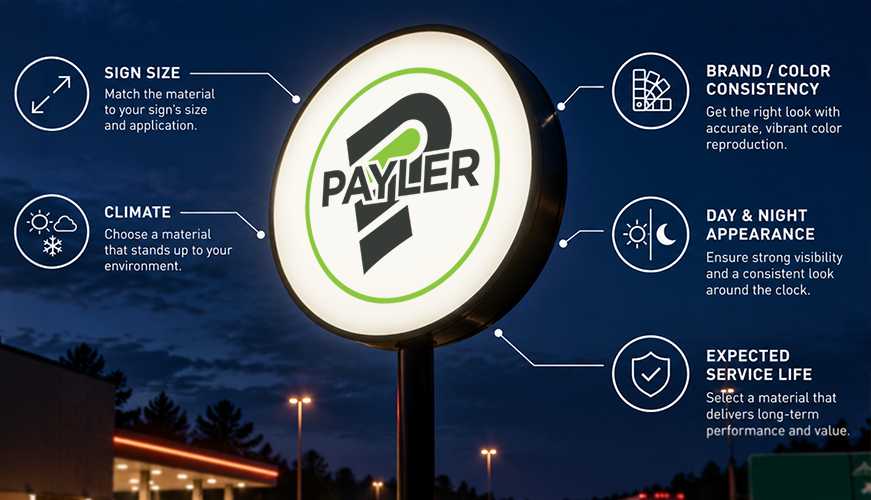
Here are five of the most important factors we consider.
1. Overall Sign Size
The size of the finished sign face is one of the first things we look at.
As a flex face gets larger, the demands placed on the material increase. Oversized exterior signs need to remain properly tensioned while withstanding wind, temperature changes, and long-term exposure to the elements.
Larger signs can also introduce additional production and installation considerations, including:
- Material strength
- Tensioning requirements
- Seam placement
- Finishing methods
- Shipping and handling
- Installation hardware
Whenever possible, reducing seams can also help create a cleaner finished appearance and simplify installation.
That’s why the overall dimensions of the sign are an important starting point when selecting the right flex face material.
2. Climate and Geographic Location
A flex face installed in Arizona faces very different conditions than one installed in Minnesota.
UV exposure, extreme temperatures, wind, moisture, and seasonal temperature swings can all affect how exterior signage performs over time.
For a single-location project, this means understanding the environment where the sign will live.
For a multi-location or national sign program, it becomes even more important because one specification may need to perform across several different climate zones.
Depending on the project, we may consider:
- UV exposure
- Heat and cold
- Wind conditions
- Moisture and precipitation
- Expected seasonal temperature changes
- Overall exposure of the sign cabinet
Material selection is only one part of the equation, but matching the flex face and finishing system to the environment can help support better long-term performance.
3. Brand and Color Consistency
Color consistency matters on every sign project, but it becomes especially important for brands producing signage across multiple locations.
A national brand may need the same red, blue, green, or other signature color reproduced across dozens or hundreds of signs, and those signs may not all be produced at the same time.
The flex face material itself can influence the finished appearance. Factors such as the base white point, translucency, ink coverage, and illumination can all affect how a printed color is perceived.
That’s why consistent materials and production processes matter.
At Payler, G7+ certified color processes help us maintain greater control over color reproduction and repeatability across production runs.
For ongoing sign programs, that consistency becomes especially valuable when replacement faces or new locations are added months or years later.
4. Day and Night Appearance

Backlit flex face signage needs to perform in two very different environments.
During the day, the graphic is primarily viewed using reflected light.
At night, light comes from inside the sign cabinet and passes through the printed flex face.
Without the right production approach, a color that looks rich and saturated during the day can appear noticeably lighter or washed out once illuminated.
Multilayer printing can help manage that difference.
Payler's range of VUTEk equipment gives us the ability to use layered printing techniques that help control opacity, color density, and light transmission for backlit applications.
These techniques can also create more advanced day/night effects, where certain parts of a sign change appearance once the cabinet is illuminated.
For that reason, we don't only ask what the sign should look like.
We also ask when and how it will be viewed.
5. Expected Service Life and Warranty Requirements
Finally, we consider how long the flex face is expected to remain in service.
A regional sign project, short-term rebrand, and nationwide signage program may all have very different expectations for longevity and warranty protection.
For many individual signs and regional programs, Payler's 20 oz Flex Face provides an excellent balance of durability, print quality, and value.
For large national rollouts or projects where standardized material specifications, extensive documentation, and warranty options are especially important, we generally recommend 3M™ Panagraphics™ III.
The goal isn't simply to specify the most expensive material or try and be the cheapest option just to get the job. It’s to ensure we help you provide your client with the best option. It's to understand the application and help you deliver the best solution for your client.
Replacing a failed flex face can involve much more than reprinting the graphic. Freight, installation crews, lift equipment, site coordination, and other expenses can make replacement significantly more costly than the material itself.
The larger and more complex the program, the more important long-term predictability becomes.
The Right Flex Face Starts With the Application
There isn't one flex face material or production method that's right for every project.
The best recommendation comes from looking at the complete application:
- How large is the sign?
- Where will it be installed?
- What environmental conditions will it face?
- How important is exact brand color?
- How should it look during the day and at night?
- How long does it need to perform?
- Does the project have specific material or warranty requirements?
Those answers help determine not only the right flex face material, but also the appropriate printing and finishing approach.
At Payler, we work exclusively with sign professionals and support projects ranging from individual oversized flex faces to complex national programs.
Have a flex face project coming up? Send us your specs and our team can help determine the right material and production approach for the job.